Choose simulation
Click an image to start the desired mode.
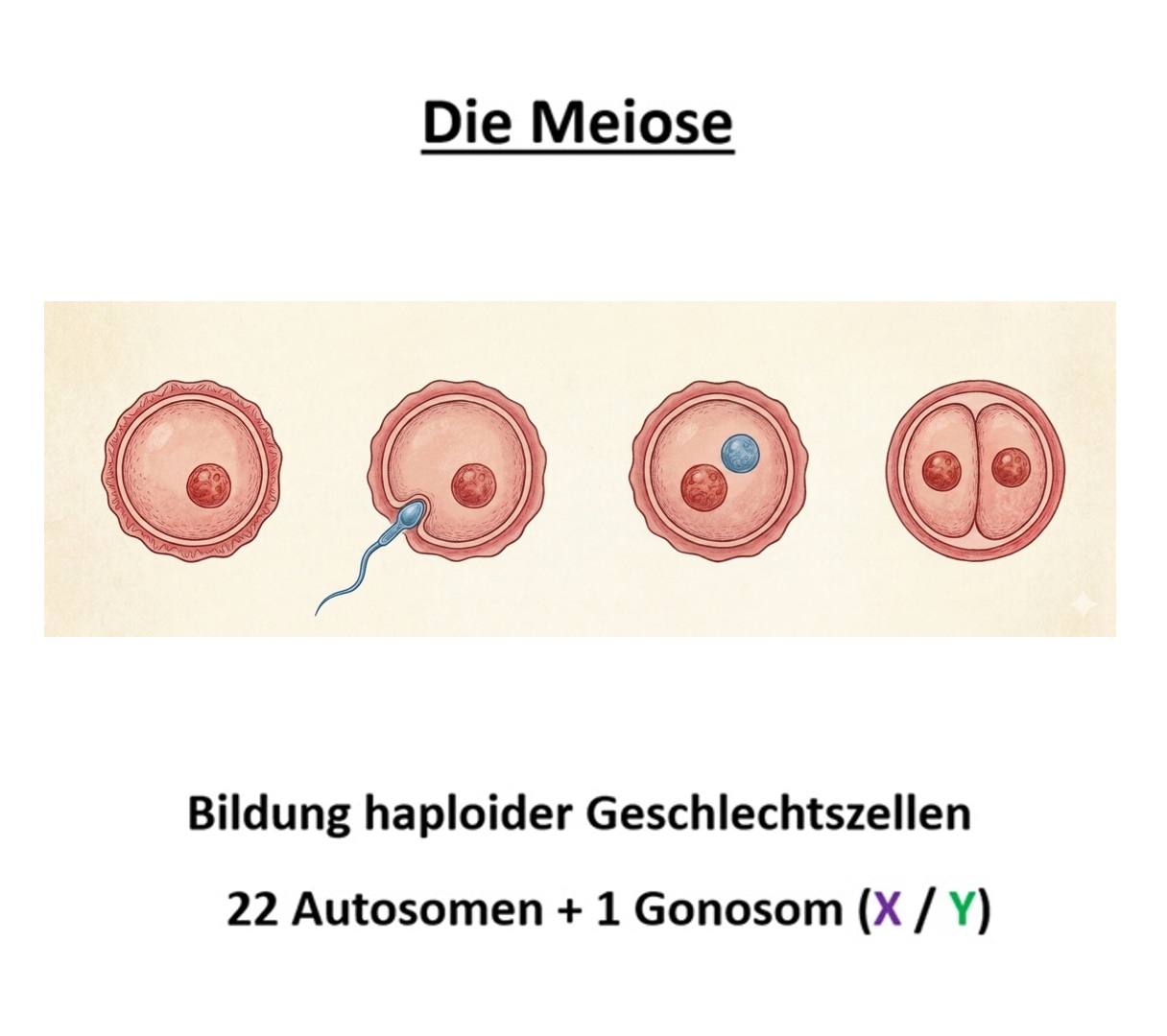
Meiose
Mitose
Compared with spermatogenesis, in which four equivalent gametes are formed, oogenesis produces one egg cell and three polar bodies.
Monosomy means that the zygote is missing one chromosome from a homologous pair. Instead of 2n, it has 2n−1.
It typically arises when, during meiosis, non-disjunction causes a gamete to receive no chromosome from that pair (a nullisomic gamete: with n=1, that means 0 instead of 1 chromosome from this pair).
Why are the red-marked examples monosomies?
In the marked cases, the gamete contains no chromosome from this autosome pair. After fertilization by a sperm cell (with 1 chromosome from this pair), the zygote contains only 1 instead of 2 chromosomes - this is a monosomy (2n−1).
Note: in a trisomy, the opposite happens - the gamete contains 2 instead of 1 chromosome from this pair (zygote: 2n+1).
Trisomy means that one chromosome is present three times in the zygote. Instead of 2n, the zygote has 2n+1.
It typically arises when non-disjunction during meiosis causes a gamete or a sperm cell to receive an additional copy of this chromosome.
Why are the marked examples trisomies?
In the marked cases there is an additional copy of this chromosome overall:
• Red: the gamete contains n+1 (two chromatids/chromosomes from this pair) and is fertilized by a normal sperm cell (n).
• Yellow: the sperm cell contains n+1 (two chromatids/chromosomes from this pair) and fuses with a normal gamete (n).
In both cases, the zygote ends up with 3 copies of this chromosome - a trisomy (2n+1).
Grade level: 9 · 12